
The move towards heat pumps is gathering pace, but replacing the heat source is only part of the picture.
For many existing buildings, the bigger challenge is understanding whether the water distribution system is actually ready for the change. Flow rates, terminal units, control valves, pumps and system temperatures all come into play, particularly in older buildings where legacy designs can vary significantly and detailed performance data may not be readily available
That all means, before a boiler is replaced, there is a more fundamental question to answer: how will the rest of the system respond?
We look at why existing water distribution systems need careful assessment before the move to heat pumps, what information is needed to understand performance and how Smart Actuators can help provide the data required to make informed decisions.
Heat Pumps Change The Demands On The System
The current focus is often on replacing the heat source, but existing terminal units, pipework and balancing valves also need to be suitable for the new flow rates.
Heat pump designs must be able to deal with lower temperature differences between flow and return, and the control valves within the system need to be selected accordingly.
Pressure Independent Control Valves (PICV) can make this easier, provided the correct valve characteristic is used. Ideally, the Delta T to each terminal unit should also be measured and monitored.
Existing Buildings Bring Different Challenges
In new buildings, these requirements can be incorporated into the design from the beginning.
Existing buildings are different.
Some may have systems that are decades old, while others may have relatively modern designs. These can range from constant volume three port systems with belt driven pumps through to variable volume systems with inverter driven pumps and Smart Actuators.
Newer systems may be easier to assess because design information, drawings and commissioning data are more likely to be available. Older buildings can present a much bigger challenge, particularly where they remain occupied and there are no plans for major refurbishment.
The Missing Piece Is Often Data
Changing from one heat source to another requires a much clearer understanding of what is happening at each terminal unit.
In many existing systems, that information is simply not available because the devices needed to collect it have either not been installed or are not being used.
Existing boilers could be used to simulate the lower temperatures associated with heat pumps, but without collecting data at each terminal unit, it is difficult to properly evaluate the effect of that change.
Reducing the temperature alone is not enough either.
If the flow rate to each terminal unit is not also increased, the system will not provide a reasonable evaluation of how a lower temperature heat source would perform.
That may also create further questions around whether the existing pump is capable of delivering the increased flow required.
Smart Actuators Can Provide Greater Visibility
One possible approach is to install Smart Actuators on some or all terminal units.
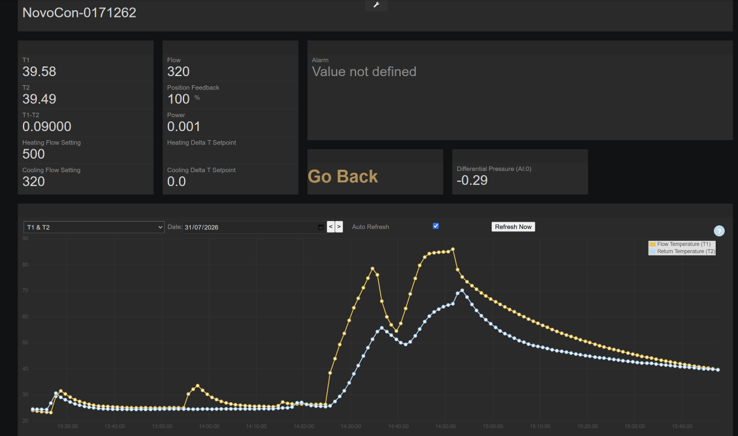
These actuators can measure flow and return temperatures while also working out the best stem position to achieve the desired return temperature.
Using BACnet, Modbus or the Internet of Things, data can then be collected on flow rates and flow and return temperatures at each terminal unit.
Smart Actuators do not necessarily require the existing PICVs to be changed. Where a heating system does not already have PICVs, a Smart Actuator and PICV could be added at the ends of circuits on individual floors to provide greater visibility of what is happening during start up and throughout the day.
The data collected can then be logged and evaluated.
Testing Lower Temperatures Before Making The Change
Once performance at the existing 80°C supply temperature is understood, the boiler supply temperature could be reduced to a new design temperature of 45°C.
The change in temperature can be matched with a change in flow rate through the Smart Actuator configuration programme, allowing valve positions to be adjusted without physically visiting the valve.
Monitoring and logging information from each terminal unit at the lower temperature can then provide useful insight into the wider impact of moving from a boiler to a heat pump before work begins.
Understanding The Whole System
Changing to heat pumps and introducing Smart Actuators should not be undertaken lightly. It requires an understanding of PICCVs, Smart Actuators and flow measurement devices, and practical hands on courses have been developed to support consultants, contractors, commissioning engineers, service engineers and maintenance engineers.
The key point is that moving to heat pumps, or any other alternative energy source, needs to be based on detailed data.
Any change to the heat source will affect the wider system. Understanding those effects before making the change is essential to developing the right strategy.
If you’d like any further support in this matter, please get in touch with the WES Hydronics team.